
Description
Product Overview
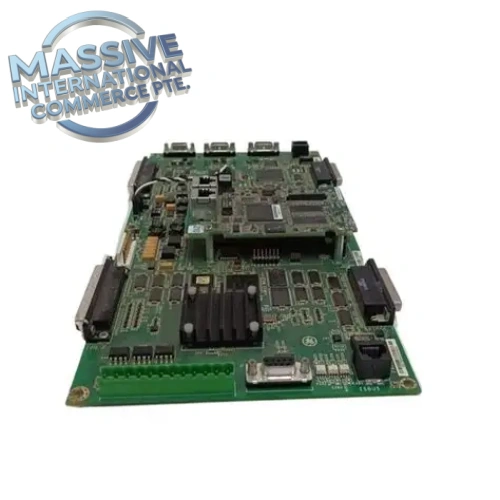
The GE IS210MACC1ACC is a MACC (Multi-Axis Control Card) for GE Vernova Mark VIe Speedtronic distributed turbine control platform. It executes high-speed closed-loop servo control for gas/steam turbine fuel valves, steam control valves and hydraulic actuators. It receives LVDT/RVDT position feedback, outputs servo drive commands and performs local control calculations. Widely used in combined cycle power plants, simple-cycle gas turbines and steam turbine control systems. It supports simplex, dual redundant and TMR configurations, and is programmed and diagnosed via ToolboxST software.
Technical Specifications
| Item | Parameter |
|---|---|
| Part Number | IS210MACC1ACC |
| Manufacturer | GE Vernova (General Electric) |
| Series | Mark VIe Speedtronic |
| Product Type | Multi-Axis Servo Control Card (MACC) |
| Control Axes | Multi-axis servo closed-loop control |
| Position Feedback | LVDT / RVDT transducer interface |
| Control Loop Rate | Deterministic microsecond-level servo update |
| Backplane Bus | Mark VIe IONet |
| Power Input | 24 VDC backplane supply |
| Form Factor | VME-style plug-in card for Mark VIe rack |
| Operating Temp | 0°C ~ +60°C |
| Storage Temp | -40°C ~ +85°C |
| Humidity | 5–95% non-condensing |
| Programming Software | ToolboxST |
| Redundancy | Supports simplex, dual and TMR redundant deployment |
| Diagnostics | Onboard channel diagnostics, watchdog, transducer fault detection |
| Certifications | CE, UL, IEC functional safety compliant |
Key Features
- High-speed multi-axis closed-loop servo control for turbine governing and safety actuators.
- Native LVDT/RVDT signal conditioning for valve position feedback, eliminating external signal conversion hardware.
- Supports TMR triple modular redundant architecture for safety-critical turbine protection and governing loops.
- Comprehensive built-in diagnostics to detect transducer open circuit, short circuit and servo drive faults.
- IONet Ethernet interface for communication with Mark VIe system controllers and HMI.
- Designed for continuous operation in power generation environments; supports hot-swap maintenance in qualified redundant racks.
- Tunable PID control algorithms optimized for hydraulic servo valves and turbine nonlinear dynamics.
Installation Notes
- Install in standard Mark VIe VME control rack, verify firmware compatibility with existing system controllers.
- Match with correct terminal board assembly for LVDT/RVDT field transducer wiring.
- Separate low-level position feedback cables from high-current power wiring to reduce EMI noise.
- Follow plant lockout/tagout procedures before card replacement, even for hot-swap maintenance.
- Backup the turbine control project in ToolboxST before removing the MACC card.
- After replacement, perform valve loop tuning, feedback calibration and full proof test before returning turbine to service.
Testing Procedure
- Visual inspection: Check PCB, front panel connectors, edge pins for scratches, corrosion or bent pins.
- Insert card into Mark VIe rack, apply 24VDC rack power and complete power-up self-test.
- Establish online connection using ToolboxST, confirm card identification and healthy status.
- Inject simulated LVDT/RVDT position signals to validate feedback reading accuracy.
- Force servo output commands and verify closed-loop response and PID performance.
- Simulate transducer faults (open/short) to confirm diagnostic alarms are reported correctly.
- Save diagnostic logs, record calibration results and tag module for spare inventory.
FAQ
Q: What is IS210MACC1ACC used for? A: It is a Mark VIe MACC multi-axis servo control card for gas and steam turbine valve governing, using LVDT/RVDT position feedback for hydraulic servo loops.
Q: What software configures this module? A: ToolboxST is used for commissioning, tuning, diagnostics and firmware updates.
Q: Can IS210MACC1ACC be hot swapped? A: Hot swap is allowed only in redundant Mark VIe rack configurations under controlled outage/maintenance procedures.
Q: What redundancy modes does it support? A: Simplex, dual redundant and TMR triple modular redundant for turbine safety and governing applications.



 Start Chat


 Send an Email


